
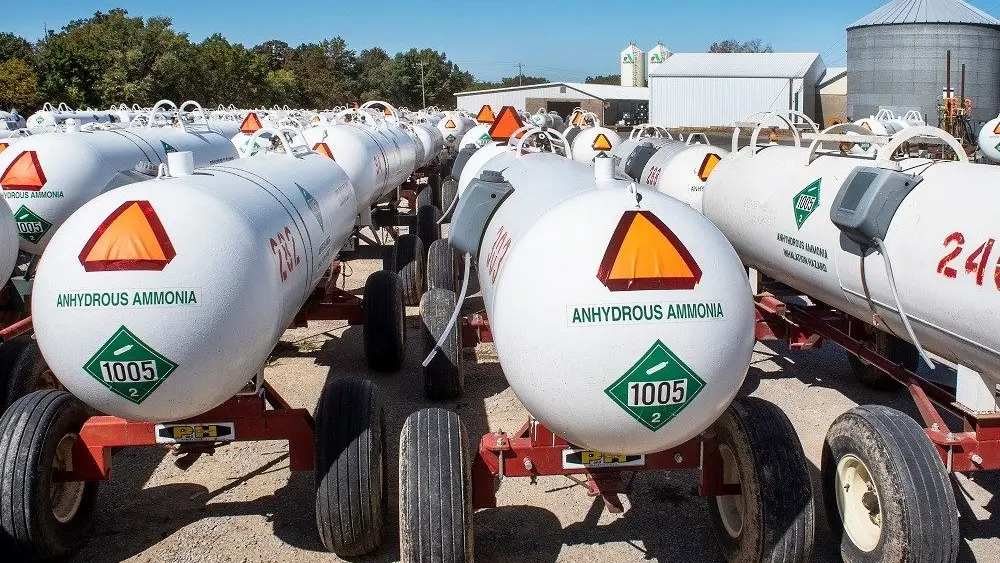
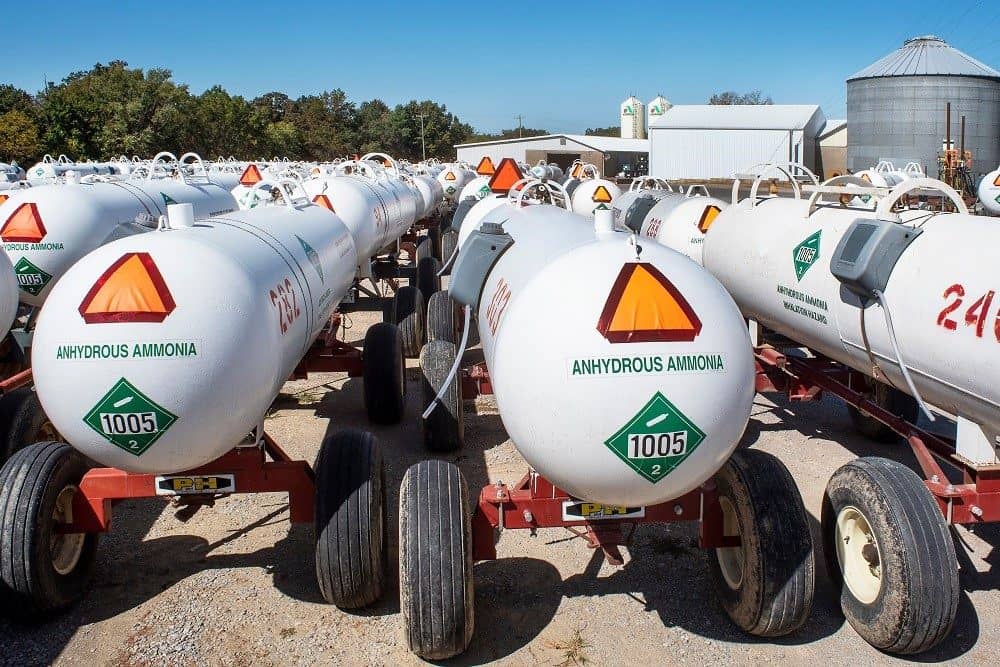
As planting season accelerates across the Midwest, farmers are turning once again to anhydrous ammonia, a nitrogen fertilizer prized for its efficiency and relatively low cost. But agricultural experts warn that the same chemical helping drive corn yields also carries significant risks when mishandled.
Anhydrous ammonia—composed of roughly 82 percent nitrogen—is widely used because it delivers more nutrients per pound than many alternatives while reducing transportation costs. Stored as a pressurized liquid and released as a gas, it is a familiar sight along rural highways, where nurse tanks move between retail facilities and farm fields during peak application periods.
Yet its chemical properties make it inherently hazardous. As a highly caustic alkali, anhydrous ammonia can cause severe burns, blindness and respiratory injury, and in some cases can be fatal. Incidents most often occur during transfer, when leaks, faulty valves or equipment failures expose workers or bystanders. In larger releases, the chemical can form a dense white vapor cloud capable of spreading quickly, at times forcing road closures, evacuations or shelter-in-place orders.
“Anhydrous means without water. And so one of the ways that anhydrous ammonia is going to hurt someone is because it’s always seeking water wherever it can find it,” said Ann Kline, lead extension educator with Purdue Extension in Noble County.
Kline said the chemical’s first danger lies in its ability to dehydrate human tissue.
“So the first one I just mentioned, dehydration, it’s going to pull water out of you. If you think about what percentage of your body is water—your lungs are 80% water. Guess where that anhydrous ammonia is going? It is going to pull water out of there. Also, think about your skin, which is up to 65% water, and it is going to pull that water out of your skin,” she said.
Immediate exposure to skin or eyes requires rapid flushing with water, she added.
“The second one is it is extremely cold,” Kline said. “The boiling point of anhydrous ammonia is -28 degrees. It’s so cold that you’ll even see when the anhydrous ammonia comes out of the hoses, they’ll have frost on them.”
Beyond dehydration and freezing injury, Kline warned of severe chemical burns that can permanently damage tissue.
“Skin is reduced to a sticky, gooey substance as the chemical burn progresses. Skin that is chemically burned by the ammonia actually is killed and not capable of healing or replacing itself. Uh, damaged tissue must be removed surgically so that healing can proceed. The results are often disfiguring,” she said.
Emergency responders face particular challenges during ammonia incidents. Water is often used to suppress vapor clouds and limit their spread, but even swift action cannot always prevent injuries. Past accidents have harmed both first responders and civilians, and large-scale releases can strain local medical systems.
To mitigate those risks, safety guidance emphasizes careful handling at every stage. Farmers are urged to routinely inspect hoses and valves, avoid overfilling tanks, and use corrosion-resistant equipment. Federal regulations also require transport units to carry at least five gallons of water for emergency first aid, and protective gear such as gloves and chemical-resistant goggles is considered essential.
Training has become an increasing priority as seasonal workers join the workforce during peak application windows. Some states now require formal safety certification, reflecting growing recognition across the agricultural sector that even minor errors can have serious consequences.
Despite those dangers, anhydrous ammonia remains a cornerstone of modern crop production. For many farmers, its economic and agronomic benefits are difficult to replace—so long as its use is paired with strict attention to safety.
CLICK BELOW for Hoosier Ag Today’s radio news report:
CLICK BELOW, as Ann Kline with Purdue Extension—Noble County provides further details on anhydrous ammonia safety on the “Your Farm” Podcast, as Hoosier Ag Today presents Your Purdue Extension—a Podcast Network.