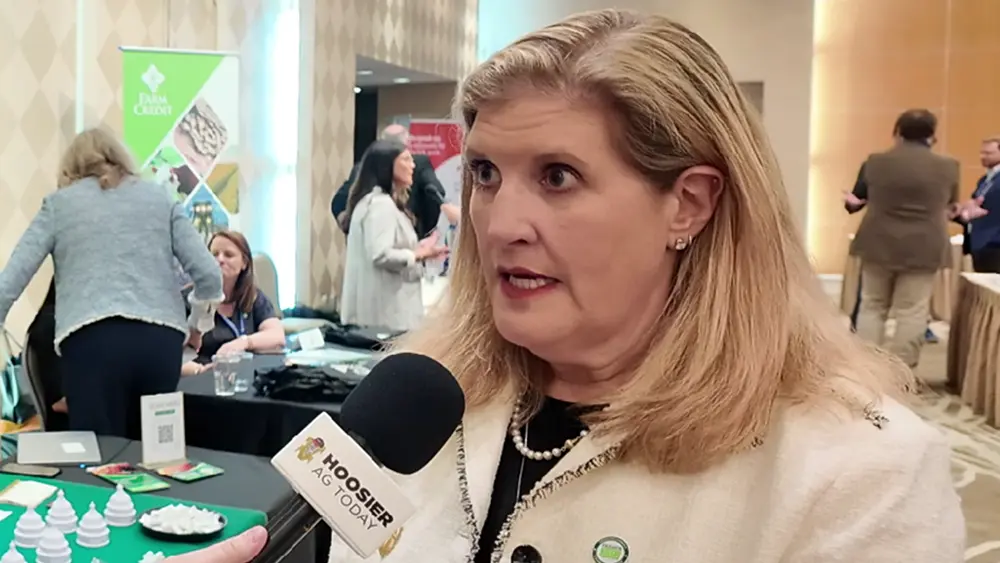

The U.S. Supreme Court heard arguments Monday in a closely watched case involving Roundup herbicide that could have a major impact on the ag industry. One ag leader tells Hoosier Ag Today she was in the courtroom as the justices heard the case.
“I got to sit in there. Now you can’t say a word, they take everything away from you: your phones, your Apple watch. You can only bring in a piece of paper and a pen, and the piece of paper can have nothing on it,” said Alexandra Dunn, President and CEO of CropLife America—a national trade association representing America’s pesticide manufacturers and distributors.
The case, Monsanto Company v. Durnell, stems from a Missouri man who was awarded $1.25 million from a jury in a state court after claiming Roundup herbicide caused his cancer. Bayer, the product’s manufacturer, is now asking the Supreme Court to overturn that ruling.
At the heart of the argument: federal versus state authority.
“The case is about consistent labeling, and we think for farmers consistent labeling is very important. So, you know, if many farmers do farm in more than one state and, you know, it’s very important as they cross those state lines and so they shouldn’t have different requirements in different states,” said Dunn.
Bayer says the EPA has consistently found glyphosate—the active ingredient in Roundup—unlikely to cause cancer, and has not required a warning label. Therefore, the company argues, state juries shouldn’t be able to contradict federal science-based decisions.
“It was a very good argument,” Dunn said. “We at Croplife America have filed a—what’s called a ‘Friend of the Court’ brief in support of the Monsanto company.”
Dunn says it’s still anyone’s guess how the justices are leaning after Monday’s arguments.
“It’s really hard to tell. They all asked questions and so it’s hard to interpret. I will say that there was a case before and it had to do with data stored on iPhones, and that case went for two hours. So, it seemed like the justices were interested in this case, but they may have lost a little steam,” she said.”
Agriculture leaders warn—if the ruling goes against Bayer, it could shake the future of crop protection, limiting tools farmers rely on to protect yields and keep food production strong.
A decision from the Court is expected by early summer.
CLICK BELOW to hear Hoosier Ag Today’s radio news report: