Trump administration officials outlined an aggressive, multi-agency strategy to address persistently high fertilizer prices, a key concern for American farmers heading into the spring planting season.
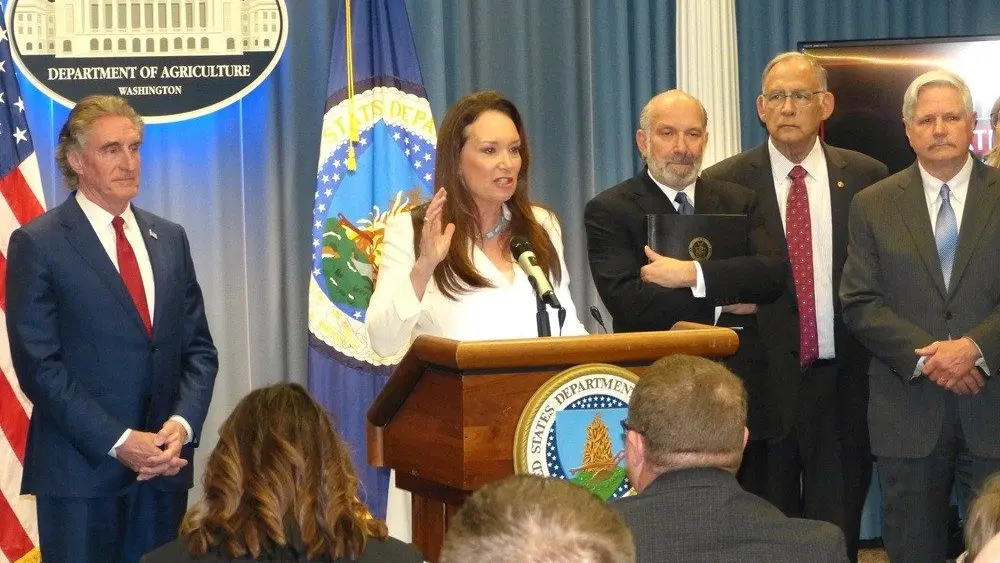
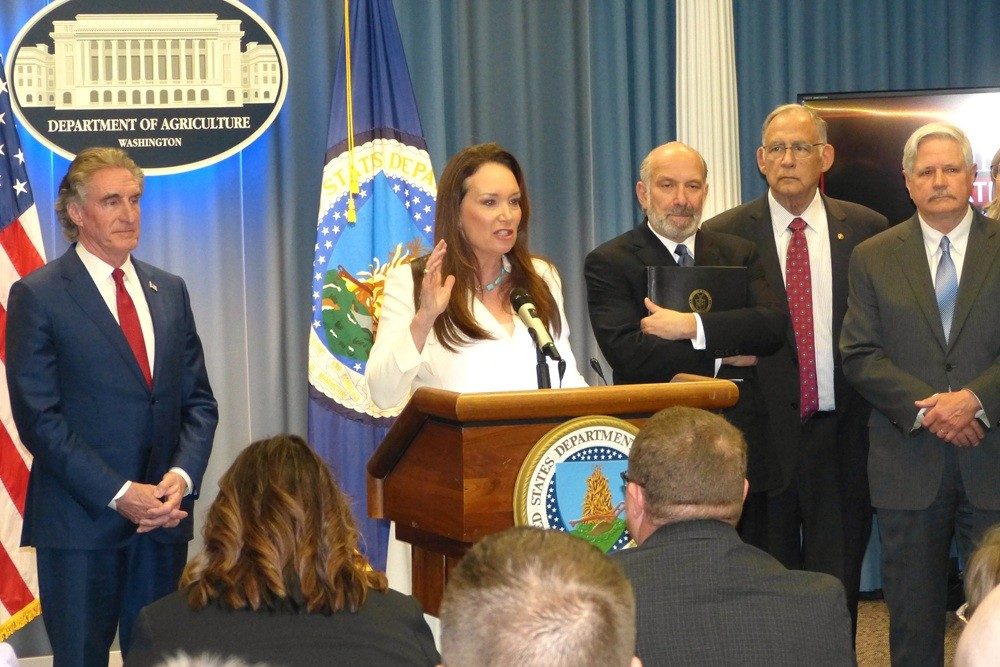
During a press conference Tuesday at USDA’s headquarters in Washington, D.C., U.S. Agriculture Secretary Brooke Rollins said consolidation in the fertilizer industry has sharply reduced competition, noting that just four companies now control roughly 75 percent of the domestic nitrogen market, while two firms dominate potash. The result, she said, has been fewer options and higher costs for farmers already operating on thin margins.
Administration officials blamed rising prices in part on global disruptions — including the war in Ukraine — and policies under the Biden administration, while emphasizing that the current effort is focused on both immediate relief and long-term structural changes.
Officials from the Trump administration appearing alongside Rollins reinforced the multi-agency scope of the effort. Interior Secretary Doug Burgum, Commerce Secretary Howard Lutnick, and EPA Administrator Lee Zeldin were among those who spoke during the press conference, each outlining steps their respective agencies are taking to expand fertilizer supply, reduce regulatory barriers, and strengthen domestic production capacity.
Short-term measures
Officials highlighted several recent steps aimed at boosting supply and easing costs:
- A temporary waiver of the Jones Act to expand shipping capacity for fertilizer imports.
- Removal of certain restrictions on fertilizer imports from Venezuela.
- Regulatory changes affecting diesel exhaust fluid rules, which officials say could increase domestic urea production.
- Coordination with private companies, including CF Industries, to expand near-term output.
They also pointed to ongoing antitrust scrutiny of fertilizer markets by the Justice Department and Federal Trade Commission, amid concerns about price-setting behavior in a highly concentrated industry.
Long-term strategy, including Indiana project
Beyond immediate relief, the administration emphasized efforts to rebuild domestic production capacity and reduce reliance on foreign suppliers. Rollins specifically pointed to an “Indiana ammonia project” as a key example of how the administration aims to boost domestic fertilizer production and lower prices.
The project, led by Wabash Valley Resources, would restart a coal gasification plant in West Terre Haute, Ind., to produce up to 500,000 metric tons of anhydrous ammonia annually. Backed by a nearly $1.6 billion loan through the Energy Department’s Energy Dominance Financing Program, the facility would repurpose a plant idled since 2016, using coal from southern Indiana and petroleum coke as feedstock.
Administration officials said the project is designed to strengthen fertilizer supply chains in the Corn Belt, reduce reliance on imports and support local economies. It is expected to create hundreds of jobs, including up to 500 construction positions and more than 100 permanent operational roles, while supporting coal mining employment in the region.
The project would also mark a first for the region as a domestic producer of low-carbon ammonia, which officials say could be cost-competitive with imports and help drive down prices for farmers and agricultural businesses.
More broadly, the administration pointed to:
- A $900 million fertilizer production expansion program.
- More than $1 billion in potential investments through a Commerce Department initiative.
- Energy Department financing for projects tied to fertilizer inputs such as ammonia.
- Accelerated permitting for mining and manufacturing projects tied to critical minerals like potash and phosphate.
Interior Secretary Doug Burgum framed the issue as one of national security, arguing that “fertilizer security” is inseparable from energy and food security.
Officials projected that, if current plans are realized, domestic nitrogen production could increase by more than 30 percent within two years, with even larger gains in phosphate and potash output.
Congressional action and farmer concerns
Lawmakers at the event said Congress is also moving to address costs. Sen. Roger Marshall (R-Kan.) announced legislation to eliminate duties on Moroccan phosphate fertilizer, which he said could reduce prices by more than 20 percent. Other bipartisan proposals aim to increase market transparency and competition.
Despite the flurry of activity, administration officials acknowledged that relief may not come quickly enough for some farmers. Rollins described the farm economy as “very fragile” and said the administration is working “around the clock” to bring down input costs.
“This is not a problem that appeared overnight,” she said. “But it’s one we are determined to solve.”
CLICK BELOW for Hoosier Ag Today’s radio news report:
CLICK BELOW to watch the full press conference (Video begins at 3:37):