
American farmers facing near-record diesel prices and increasingly squeezed harvest margins are getting a major, but temporary, break on fuel costs.
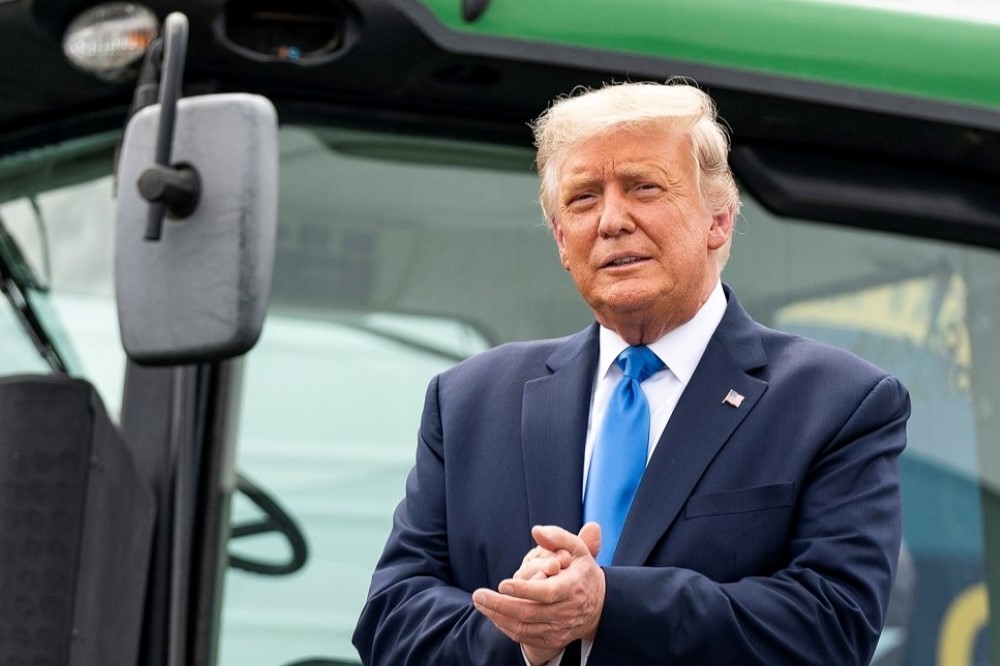
President Donald Trump signed an executive order Monday directing the federal government to expand access to tax-free, red-dyed diesel and defer certain federal diesel fuel tax obligations through the end of 2026. The move comes as farmers across the Corn Belt are pushing through harvest while confronting elevated costs for fuel, fertilizer and other critical inputs.
For producers already watching every dollar of harvest expense, the timing could be significant.
The federal excise tax on on-road diesel is 24.4 cents per gallon. Under the order, Treasury is directed to determine within five days whether the administration can defer certain diesel excise-tax payments incurred from Oct. 5 through Dec. 31. If authorized, those payments could be deferred without penalties or interest.
More immediately, the order directs the Internal Revenue Service to provide penalty relief for the use of dyed diesel on highways during that same period.
That could allow farmers to tap into the less-expensive red-dyed diesel they traditionally use in tractors, combines and other off-road equipment—and use it for road hauling during harvest.
The White House says the action is designed to put money back into the pockets of farmers, truckers and other workers at a time when diesel costs have become a major economic burden.
Trump announced the move Monday night from a rally stage in Nebraska, saying he hoped the waiver would not be needed for long.
“We’re not going to need it long, I hope,” Trump said.
Every Cent Matters at Harvest
For farmers, the issue goes well beyond the price posted on a fuel pump.
Harvest requires an enormous amount of diesel. Combines consume fuel in the field, while tractors move grain and semis haul corn and soybeans to elevators, ethanol plants, livestock operations, processors and river terminals.
And in 2026, those fuel costs are arriving on top of an already difficult farm economy.
Indiana diesel prices recently surged to a record $6.92 per gallon on Sept. 24, putting additional pressure on producers who were already dealing with higher fertilizer and other input expenses.
For a farmer moving hundreds or thousands of acres through harvest, a reduction of roughly 24 cents per gallon on eligible fuel can quickly add up.
American Farm Bureau Federation President Zippy Duvall says the relief comes at exactly the right time.
“Every cent per gallon matters when you’re running a fleet of grain trucks or hauling cattle hundreds of miles,” Duvall said.
The American Soybean Association also welcomed the order, saying high fuel costs are directly affecting soybean farmers’ bottom lines as the 2026 crop moves to market.
That connection is especially important this fall. A farmer may have a strong yield in the combine hopper, but every additional dollar spent getting that crop out of the field and to market cuts into the return.
Indiana Farmers Already Had a Head Start
Trump’s action follows similar steps already taken in Indiana.
Indiana Gov. Mike Braun renewed the state’s energy emergency declaration Sept. 30, allowing farmers to use untaxed, red-dyed diesel for farm-related activities, including semi-truck road hauling, through Nov. 4.
The Indiana action was welcomed by farm groups as harvest accelerated and diesel prices approached $7 a gallon.
But there was a significant problem: state relief does not automatically eliminate federal penalties.
That became a major concern for Indiana State Rep. Beau Baird, R-Greencastle, who had pushed for state and federal action because Indiana farmers frequently cross state lines to deliver grain.
Under federal law, using dyed diesel for an unauthorized highway purpose could result in penalties beginning at $1,000 per violation.
That created an especially serious problem for farmers near Indiana’s borders.
A producer could legally fuel a grain truck with dyed diesel under Indiana’s emergency order, then potentially face federal enforcement after crossing into Illinois, Ohio, Michigan or Kentucky.
Trump’s new federal order directly addresses that state-line problem by directing the IRS not to impose certain penalties for dyed diesel used on highways from Oct. 5 through Dec. 31.
But Relief May Not Mean Cheaper Fuel Everywhere
The order is not necessarily a guarantee that every farmer will immediately see a full 24.4-cent-per-gallon reduction.
Energy experts and economists have raised questions about how quickly the market can respond, particularly because the infrastructure for distributing dyed diesel is more limited than the system used for conventional on-road diesel.
If demand for red-dyed diesel suddenly jumps, supplies could become strained in some areas.
The order therefore directs the U.S. Department of Agriculture to work with agricultural cooperatives, rural fuel distributors, farm-supply organizations and other stakeholders to help ensure adequate dyed-diesel supplies in high-demand areas.
It also encourages states to take corresponding action.
The White House estimates the broader relief could save drivers as much as $100 per fill, depending on fuel consumption and prices.
A Temporary Lifeline During a High-Cost Harvest
The diesel order arrives as farmers are navigating one of the most financially challenging points of the production cycle.
The bills for seed, fertilizer, chemicals, machinery, repairs and land have already been incurred. Now producers must spend heavily to harvest the crop, dry it when necessary, haul it to market and prepare for the next growing season—all while commodity prices and farm margins remain under pressure.
That makes fuel more than another line item in a farm budget.
It is the cost of getting the crop from field to market.
The administration’s order also directs Treasury to explore ways—including potential legislation—to eliminate the obligation to eventually repay taxes that are deferred under the order. For now, however, the immediate relief is temporary, with the covered period running through Dec. 31.
For farmers racing against weather and rising costs, that window matters.
The combines are already rolling. Grain trucks are already lining up at elevators. And with every additional load comes another fuel bill.
For producers trying to protect an already-thin harvest margin, Washington’s message is clear: at least through the end of the year, the federal government is trying to take some of the pressure out of the fuel tank.