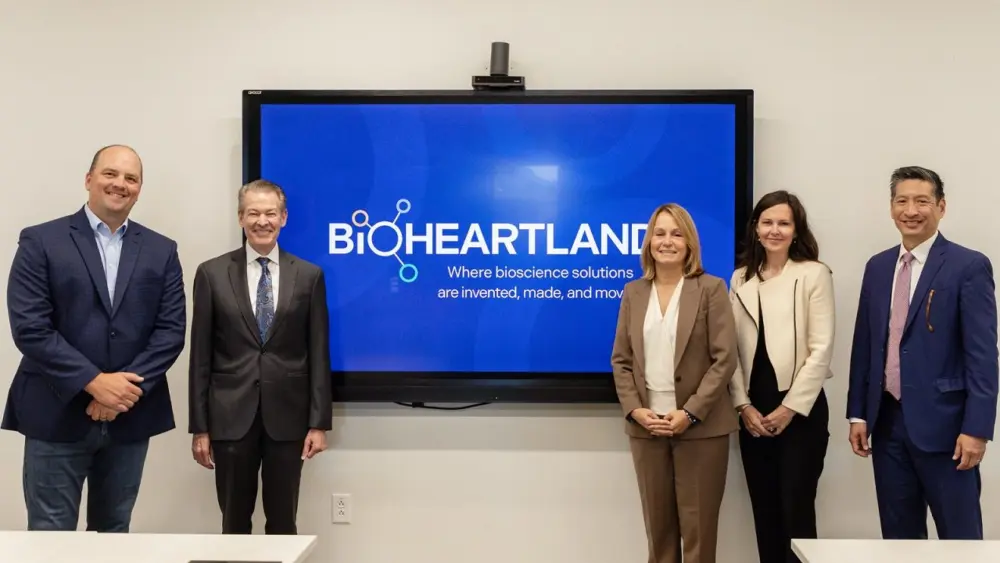
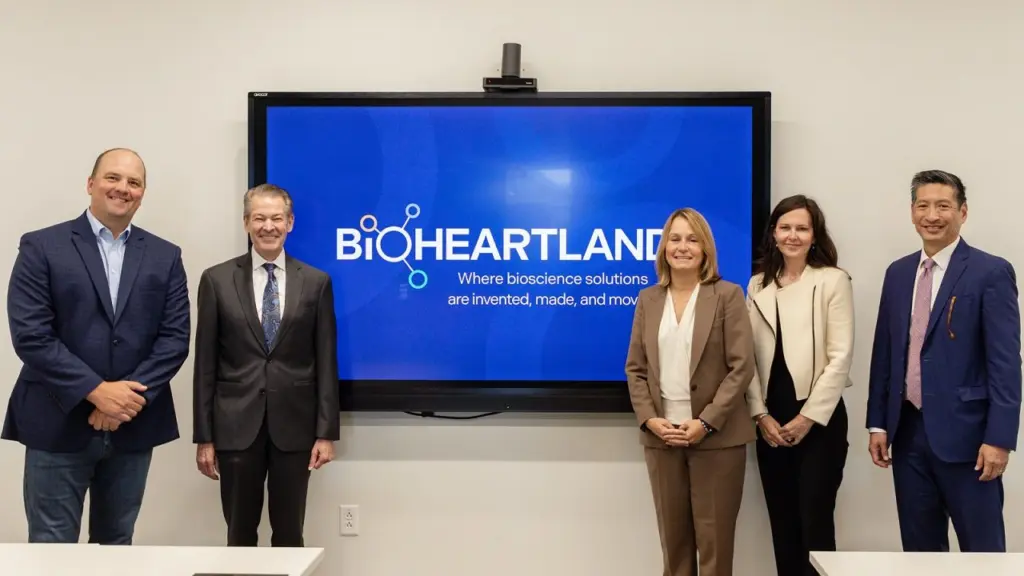
Indiana’s top business, agriculture and life sciences leaders on Tuesday launched “BioHeartland,” a new regional identity aimed at unifying the state’s sprawling agbioscience sector and sharpening its pitch to global investors, companies and talent.
The initiative, developed by the Indiana Corporate Partnership and its affiliated groups — BioCrossroads and AgriNovus Indiana — in partnership with the Central Indiana Regional Development Authority, seeks to bring coherence to a sector that spans human health, animal health and plant science.
State leaders say the branding effort is more than a marketing exercise. It is a strategic attempt to position Indiana — already a manufacturing and export heavyweight in pharmaceuticals and agricultural innovation — as a fully integrated bioscience hub capable of competing with coastal clusters for the next wave of investment and discovery.
“Indiana is a powerhouse in human, animal and plant biosciences, but our story has not been told with the clarity, consistency or urgency it deserves,” said Melina Kennedy, CEO of the CEOs of Indiana Corporate Partnership. “What makes this region different is not just that we make bioscience solutions, we are also a hotbed of invention and discovery, with the manufacturing strength, logistics infrastructure and collaborative spirit to move innovations into the world. BioHeartland gives us a shared identity to help investors, companies and talent understand the full value of what Indiana offers.”
Indiana’s bioscience industry already generates more than $125 billion in direct economic impact, according to state leaders, and leads the nation in pharmaceutical and life sciences exports. Officials say the new identity is intended to connect the dots across research labs, production facilities and global supply chains — a continuum they argue is rare in a single region.
“Indiana’s life sciences sector has reached a remarkable level of scale because of decades of collaboration across industry, academia, government, philanthropy and investors,” said Vince Wong, president and CEO of BioCrossroads. “BioHeartland helps connect that story across research, development, manufacturing, talent and entrepreneurship, and gives us a clearer way to show how Indiana’s life sciences ecosystem is producing real results for people here and around the world.”
For Indiana’s farmers and agbioscience businesses, the stakes are particularly high. The state sits at a unique intersection of agricultural production and life sciences innovation, where advances in plant genetics, animal health and precision agriculture increasingly shape both yields and global food systems.
Leaders at AgriNovus Indiana say BioHeartland could help accelerate the development and deployment of technologies that directly affect farm profitability and sustainability — from improved seed traits to animal health products and data-driven tools that optimize inputs.
“Indiana is home to global leaders in human, animal and plant health – a powerful intersection for innovation and our competitive advantage,” said Christy Wright, president and CEO of AgriNovus Indiana. “BioHeartland tells our connected story, showing the state’s ability to bring new solutions to market that address critical needs for farmers, consumers and communities across the world.”
That “connected story” is already visible across Indiana’s agricultural economy. Farmers increasingly rely on bioscience-driven tools — from crop protection innovations developed by companies such as Corteva to animal health breakthroughs from Elanco — many of which are researched, tested or manufactured within the state. By aligning those efforts under a single banner, officials hope to attract more capital and talent that can speed the path from laboratory discovery to on-farm application.
The effort also reflects a broader push by state government to expand high-wage jobs in both agriculture and life sciences. Gov. Mike Braun has committed $1 billion over the next decade to grow the sectors, with a goal of creating 100,000 new jobs tied to innovation in plant, animal and human health.
Industry leaders say Indiana’s advantage lies in its unusual concentration of capabilities. Global firms such as Eli Lilly and Company, alongside a network of startups and research universities including Purdue University and Indiana University, operate within close proximity to advanced manufacturing hubs and logistics infrastructure.
That proximity, supporters argue, allows ideas to move more quickly from discovery to commercialization — a dynamic that could prove critical as global competition intensifies for bioscience leadership.
BioHeartland will make its international debut next month at the BIO International Convention in San Diego, where Indiana officials plan to promote the brand to investors and industry leaders.
Whether the new identity translates into measurable economic gains remains to be seen. But for a state whose economy is deeply tied to both agriculture and life sciences, leaders say the effort is about ensuring Indiana is not just part of the conversation — but leading it.
For farmers, that could mean faster access to new technologies, stronger local supply chains and expanded markets. For agbioscience businesses, it offers a clearer signal to the world that Indiana is not just a place where products are made, but where the future of food, health and agriculture is being shaped.
CLICK HERE for more information about BioHeartland.