
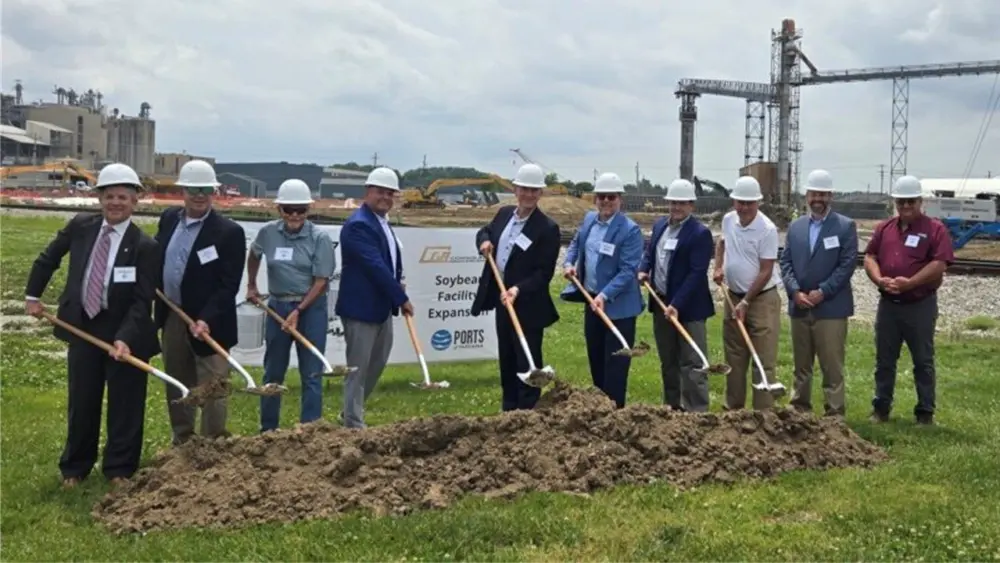
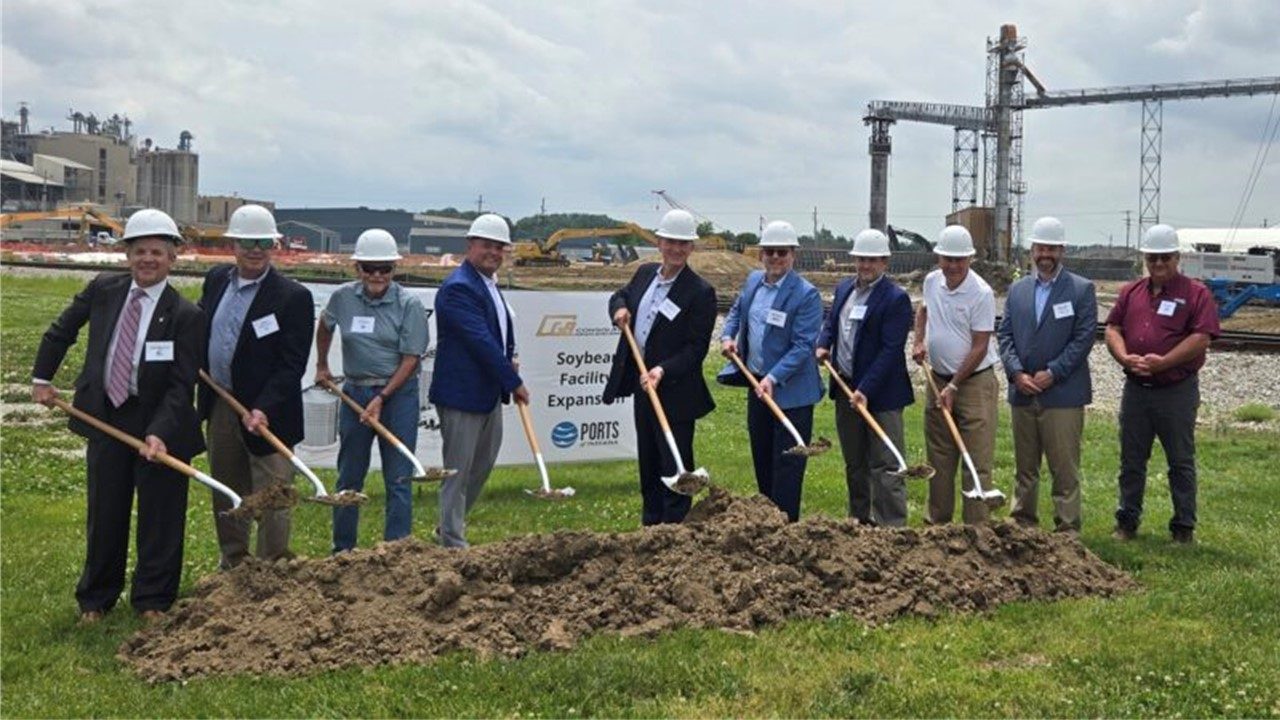
State and local officials recently broke ground on a $47 million expansion of Consolidated Grain and Barge Co.’s operations at the Ports of Indiana–Mount Vernon, a project expected to reshape how soybeans move from Hoosier farms to global markets while marking the largest investment at the state’s busiest port in more than two decades.
The project, led by Consolidated Grain and Barge Co., is designed to triple grain handling capacity tied to its soybean processing operations along the Ohio River. The company currently processes about 50 million bushels of soybeans each year at the Mount Vernon facility, producing soybean oil, meal and hulls used by livestock producers and food manufacturers worldwide.
For Indiana farmers, the expansion promises more than just increased capacity. By adding 4.25 million bushels of storage and boosting truck unloading capacity by 200 percent, the project is expected to ease bottlenecks that can slow deliveries during peak harvest periods. A redesigned unloading system will allow trucks to discharge full loads without repositioning, a change aimed at cutting wait times, reducing congestion on port roads and lowering transportation costs — savings that can directly improve margins for grain producers facing tight economics.
“CGB has been a long-standing leader in Indiana agriculture, and this investment at Ports of Indiana-Mount Vernon strengthens two of our greatest assets – world-class infrastructure and a leading agriculture economy,” said Indiana Gov. Mike Braun. “Expanding CGB’s port facilities helps Hoosier farmers move crops more efficiently to global markets, supports rural communities, and reinforces Indiana’s leadership in agriculture and trade.”
The Mount Vernon port, a 1,200-acre complex on the Ohio River, serves as a critical export hub for one of the nation’s top soybean-producing states. With connections to five Class I railroads and access to the inland waterway system, the facility enables grain to move efficiently by barge to domestic processors and international buyers. Officials say the added capacity will help ensure that Indiana soybeans remain competitive in global markets, particularly as demand grows and supply chains face increasing pressure.
CGB executives said the investment reflects both rising volumes and long-term confidence in the region’s agricultural base. Soybean throughput at the Mount Vernon site has climbed more than 60 percent over the past decade, straining existing infrastructure and prompting the need for expanded storage and faster truck handling.
“We strongly value our relationship with the state of Indiana, Ports of Indiana and the Mount Vernon community, and this investment centers on serving our farmers and the local community,” said Tom Malecha, executive vice president of CGB Enterprises, Inc.. “By improving traffic flow and reducing wait times, CGB is making soybean delivery at Mount Vernon more efficient while positioning the facility for the future. This port is an ideal location for growing our business and continuing to expand the value we bring to the agricultural, energy and food sectors.”
The expansion will also include a new conveyor system linking multiple sites within the port, allowing grain to move more seamlessly between storage, processing and shipping points. That integration is expected to enhance reliability for producers and buyers alike, particularly during periods of heavy demand.
“CGB is a world-class company that has been a tremendous partner at our Ohio River ports for nearly three decades,” said Jody Peacock, chief executive of Ports of Indiana. “This investment demonstrates CGB’s strong commitment to Indiana agriculture, our port, and future growth opportunities that support local farmers. It also highlights the strategic competitive advantages Indiana’s ports create through robust barge and rail connections in the heart of one of the nation’s most productive agricultural regions.”
Construction is expected to be completed in 2027.
Beyond the immediate construction impact, agricultural leaders say the expansion could have lasting effects for Indiana’s grain economy. Faster turnaround times at delivery points reduce fuel use and labor costs for farmers and trucking companies, while expanded storage can help producers better time their sales rather than being forced to move grain during harvest gluts when prices are typically weakest.
In an industry where margins are often measured in pennies per bushel, those efficiencies — combined with improved access to export channels — can translate into stronger farm income and greater resilience for rural communities tied to agriculture.