A Purdue University–affiliated startup working to reshape how staple crops are bred has secured new federal funding aimed at speeding the development of hardier, more efficient wheat — a step researchers say could ripple across global food systems.
Novin AgriTech, a young company founded on agbioscience technology developed at Purdue University, has been awarded an eight-month, $174,906 Small Business Innovation Research Phase I grant from the U.S. Department of Agriculture. The funding, administered through the agency’s National Institute of Food and Agriculture, will support efforts to validate the company’s gene-delivery platform and advance it toward commercial use.
At the center of the project is a push to improve nitrogen use efficiency — a trait that allows crops to grow using less fertilizer, reducing costs for farmers while limiting environmental runoff. Researchers will work to introduce that trait into elite wheat varieties, building on a technology designed to bypass some of the slow, labor-intensive steps that have long defined traditional plant breeding.
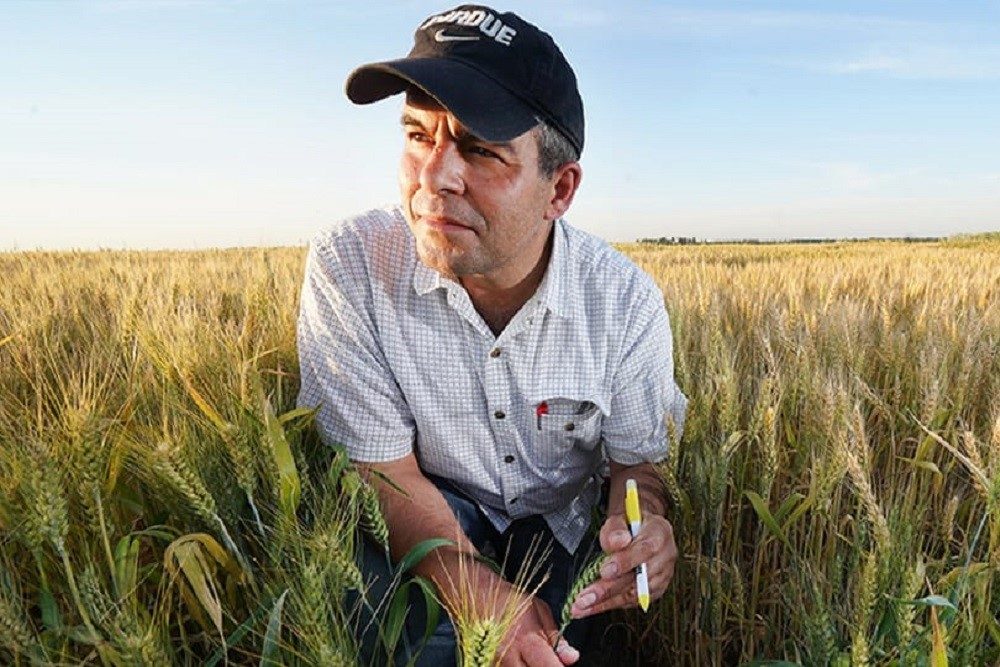
Mohsen Mohammadi, a co-founder of Novin AgriTech and an associate professor of plant breeding and genetics at Purdue, said the grant marks a critical transition point from laboratory research to real-world application.
“The project will reinforce Novin AgriTech’s positioning as a platform company,” Mohammadi said. “Our mission is to empower the cereal crop ecosystem with practical, scalable and future-ready solutions that tackle the evolving challenges of food security, health, resource efficiency, and crop resilience to biotic and abiotic stresses.”
The company’s proprietary platform — known as InPACT — allows scientists to directly modify elite crop varieties without relying on tissue culture, a time-consuming process that can limit scalability. By combining that system with a nanoparticle-assisted gene delivery method, researchers say they can accelerate the development of improved crops while maintaining consistency across different genetic backgrounds.
If successful, the eight-month project is expected to provide technical validation that the platform can deliver commercially relevant traits quickly and at scale. Mohammadi said that proof point could open the door to broader applications, including disease resistance and tolerance to environmental stress, not only in wheat but also in crops such as barley, oats and sorghum.
The funding also reflects growing federal interest in technologies that promise to address the twin pressures of climate change and rising global food demand. Wheat remains the most widely cultivated food crop in the world, and even incremental improvements in efficiency or yield can have outsized impacts.
For Novin AgriTech, the grant is as much about positioning as it is about research. Demonstrating measurable gains in nitrogen efficiency could help the company attract additional federal funding, private investment and partnerships with larger agricultural biotechnology firms.
“In summary, completion of this project will transform the technology from technology demonstration into a high-value product by validating real-world nitrogen efficiency gains; reducing adoption risk; and strengthening Novin AgriTech’s positioning for Phase II funding, industry partnerships and market entry,” Mohammadi said.
The company has already taken steps in that direction, including a Cooperative Research and Development Agreement with the USDA’s Agricultural Research Service, which has helped advance its gene-editing techniques. Earlier support from Purdue’s innovation funding programs also helped generate the molecular data underpinning the platform.
Beyond the immediate project, Novin AgriTech’s approach reflects a broader shift in agricultural science — one that seeks to compress decades of incremental breeding progress into years, or even months. By enabling faster, more precise improvements in staple crops, researchers say such technologies could play a central role in strengthening food security while reducing agriculture’s environmental footprint.
Whether that promise translates from experimental plots to farmers’ fields will depend on the results of efforts like the one now underway — a tightly timed, federally backed test of whether a new generation of crop science can deliver on its ambitions.